The Genesis of a Movement: From Tragedy to Widespread Dissent
A disturbing video, lasting mere seconds, captured a man being assaulted by police officers in Valjevo, a city approximately 90 kilometers (56 miles) southwest of Belgrade. This footage, recorded on August 14, 2025, quickly became an enduring symbol of alleged police brutality during student-led demonstrations that have since swept across Serbia. In the year following this incident, these protests have burgeoned into a significant social force, directly challenging the prolonged political dominance of President Aleksandar Vucic, who has governed Serbia for over a decade. Vucic has attempted to navigate a complex geopolitical landscape, maintaining close ties with Moscow while simultaneously affirming Serbia's aspiration for European Union membership.
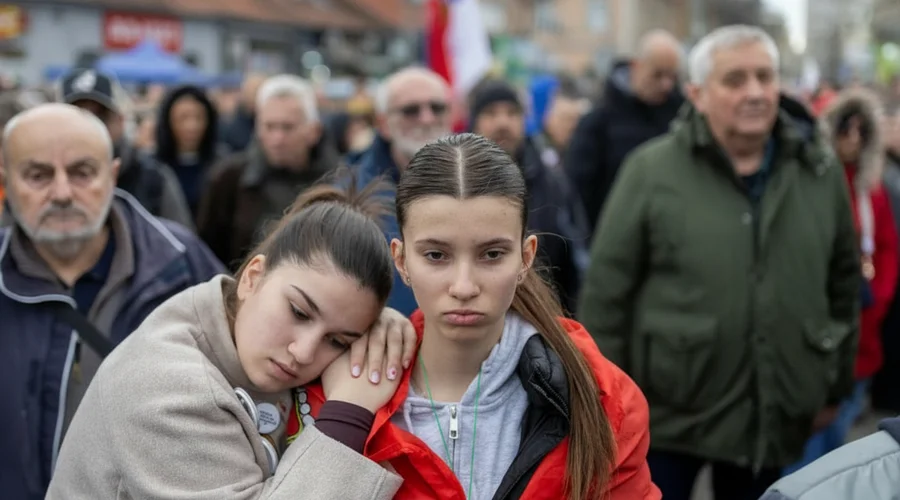
Initially, the student protests were ignited by the collapse of a concrete canopy at the Novi Sad railway station in November 2024, an event that tragically claimed 16 lives. The initial demands focused on accountability for this disaster. However, as the movement gained momentum, its scope broadened considerably. Blockades emerged nationwide, and hundreds of thousands of citizens took to the streets. The students' objectives expanded beyond the initial call for justice, evolving into a wider demand for fundamental political reform.
Valjevo: A Microcosm of Serbia's Transformation
Valjevo serves as a critical barometer for measuring the extent of societal change in Serbia and the potential trajectory of the student movement. Darija Rankovic, editor-in-chief of the news portal Kolubarske.rs, who has extensively covered the city's political and social dynamics, describes Valjevo as having experienced "a deep trauma" on that pivotal night. Rankovic herself recently became the target of a public smear campaign, with government-aligned media outlets accusing her of attempting to "bring down the state."
Rankovic articulated the profound impact of such attacks: "When you experience such a coordinated attack on national television, followed by the most vulgar insults about your physical appearance and shameless lies about 'extortion', 'blackmail' and 'bringing down the state', it is natural for your sense of personal and professional security to collapse." She emphasized the perilous position of independent journalists in the current climate. "When the highest-ranking state officials and their media mouthpieces fuel conflicts and label journalists as 'enemies' or 'destroyers of the state', they are deliberately putting a target on the forehead of all of us who are simply doing our jobs in the public interest," she stated.
Despite the threats, Rankovic remains resolute, intending to cover an upcoming anniversary rally in Valjevo. She noted that "the consequences of that social rupture and the erosion of trust are still being felt in everyday life, a year later."
Contested Narratives and Unanswered Questions
Authorities have maintained that the police's use of force was lawful, asserting it was a necessary response to public aggression and essential for restoring order. However, Tomislav Markovic, a Belgrade-based writer with deep insights into Serbia's political and social landscape, highlighted subsequent events that cast doubt on this narrative. He recalled how, the day after the protests and police actions, masked assailants vandalized a café in Valjevo, injuring an employee, and then attacked an auto repair shop, assaulting its owner and customers. Markovic contends that no one was held accountable for these incidents, directly attributing this lack of justice to President Vucic and his Serbian Progressive Party (SNS), who have held power for 14 years.
Markovic praised the student movement, stating, "The students awakened an enormous energy that had been suppressed for years in people who had been languishing under Aleksandar Vucic’s regime – hopeless, depressed and inactive, convinced that nothing would ever change." He pointed out that many of the students currently protesting were children when Vucic ascended to power, having witnessed only "the arrogance, plunder, violence and cruelty of the ruling Progressives."
Nevertheless, Markovic also expressed concern over the increasing visibility of nationalist symbols and rhetoric within the student movement. The re-emergence of nationalist tropes, including references to "sacred Serbian lands," has raised alarms among Serbia's neighbors, particularly Bosnia and Herzegovina, Kosovo, and Montenegro, who perceive this as a potential threat. This development has led to disillusionment among some more liberal citizens and has somewhat diminished the widespread support the students initially garnered across the region. While a complete political and ideological transformation of Serbia appears challenging, Markovic believes that the most crucial step would be the removal of Vucic and the SNS from power.
The Path Forward: Navigating Ideological Complexities
Aida Corovic, a human rights activist, has been a steadfast supporter of the students since the protests began, even providing them with food for months. However, she offers a nuanced perspective on their movement. "I am still with the students. They are the largest and most serious alternative to Aleksandar Vucic’s regime. But precisely because of that, I cannot close my eyes to developments that could harm them and ultimately destroy them," she remarked.
Corovic emphasized that the movement cannot be isolated from the societal context in which these students matured—a society significantly shaped by nationalist propaganda and the enduring legacy of the 1990s conflicts. "They grew up in an extremely nationalist environment," she noted. Having personally experienced the conflicts of the nineties, Corovic understands the potential dangers of nationalist flirtations. Yet, she cautions against broad generalizations, asserting that the majority of students remain democratically oriented, devoid of nationalist or right-wing aspirations.
For Corovic, Valjevo has become emblematic of a larger issue: the state's interaction with protesting citizens and the fundamental question of whether Serbia can ensure accountability for police actions. She believes that as long as the movement focused on demanding accountability for the railway station collapse, it could unite individuals with diverse political viewpoints. However, once a movement begins to aspire to power, it must inevitably confront the question of what kind of Serbia it ultimately aims to construct.