North Korea's Recent Missile Launch
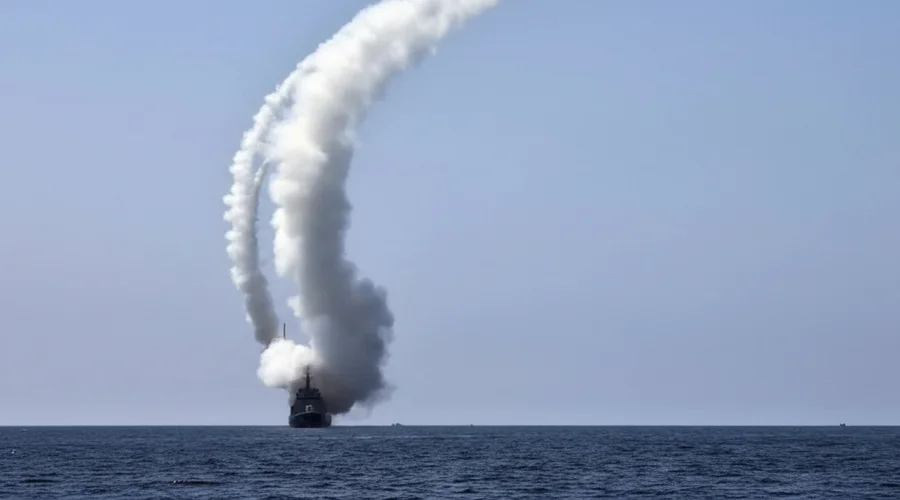
North Korea conducted a ballistic missile launch into the waters off its eastern coast, an event that occurred just days prior to the commencement of the annual Ulchi Freedom Shield military exercises involving the United States and South Korea. The missile, launched at approximately 6 a.m. local time (21:00 GMT), marks the second such test reported within a week. This series of launches takes place amidst heightened concerns regarding Pyongyang's developing military ties with Russia and its ongoing expansion of weapons programs.
While North Korea has not yet issued an official statement regarding this latest launch, it has historically and consistently denounced the annual joint military drills conducted by the US and South Korea. Pyongyang frequently characterizes these exercises as preparations for an invasion. Conversely, Washington and Seoul maintain that these drills are strictly defensive in nature, designed to enhance their readiness against potential aggressions from North Korea.
Details of the Incident
According to South Korea's Joint Chiefs of Staff, the ballistic missile was launched from the Wonsan area in Kangwon Province, a region known for its port city and naval base. The missile traveled over 700 kilometers (435 miles) before impacting waters situated between the Korean Peninsula and Japan. Japanese authorities also detected the launch, confirming that the missile landed outside Japan's exclusive economic zone.
Following the launch, South Korea's Office of National Security convened an urgent meeting, expressing significant concern over North Korea's continued ballistic missile tests. The office reiterated calls for Pyongyang to cease such provocations, which are in violation of multiple UN Security Council resolutions. This recent launch follows another ballistic missile firing from the same location six days prior, an event also detected by Seoul, Washington, and Tokyo, though unconfirmed by Pyongyang.
Interpreting North Korea's Actions
Although North Korea has not provided an explicit explanation for the missile launch, analysts widely suggest that its timing is a deliberate warning ahead of the imminent US-South Korea military exercises. North Korea has a history of responding to major joint drills by Washington and Seoul with missile tests and assertive rhetoric, viewing these exercises as hostile acts.
Lim Eul-chul, an expert on North Korea at Kyungnam University in South Korea, noted that Pyongyang consistently reacts to joint military exercises. He interprets the latest launch as a signal that North Korea is closely monitoring the upcoming drills and is prepared to take further actions if deemed necessary.
The Ulchi Freedom Shield Exercises
The Ulchi Freedom Shield exercises are scheduled to take place in South Korea from August 17 to August 27, encompassing locations on and around the Korean Peninsula. These drills will involve approximately 18,000 South Korean troops and personnel from the US contingent, which comprises roughly 28,500 troops stationed in South Korea.
Both the US and South Korea assert that these military training exercises serve purely defensive purposes. They emphasize their necessity in light of North Korea's nuclear weapons program and its continuous development of missile and other military capabilities. The drills are specifically tailored to counter Pyongyang's evolving nuclear and conventional weapons advancements. Furthermore, this year's exercises also consider North Korea's increasing military collaboration with Russia. Colonel Ryan Donald, spokesperson for the US and South Korean Combined Forces Command, recently suggested that North Korean soldiers might be applying lessons learned from assisting Russia in the conflict in Ukraine.
Frequency of Missile Tests and Broader Context
South Korea reports that this latest launch marks North Korea's eleventh suspected ballistic missile test this year. Hong Min, a senior researcher at the Korea Institute for National Unification, indicated that while the test likely aligns with North Korea's existing weapons development objectives, the decision on when to conduct such a test is inherently political, suggesting a strategic timing to convey a message prior to the exercises. All such ballistic missile launches are prohibited under multiple UN Security Council resolutions.
The current missile launch is part of a broader pattern of increased weapons testing by North Korea. This escalation in testing has been observed since diplomatic efforts between North Korean leader Kim Jong Un and then-US President Donald Trump faltered in 2019. These tests also occur amidst deteriorating regional tensions. South Korea and Japan have condemned the recent launch, with Seoul reaffirming its readiness to respond to any provocation in conjunction with the United States.
Pyongyang has also vocalized its disapproval of South Korea's plans for nuclear-powered submarines and has accused Japan of moving towards greater militarization. Earlier this month, Kim Yo Jong, sister of North Korean leader Kim Jong Un, issued a warning about potential 'additional military options' following Japan's test-firing of a US-made Tomahawk cruise missile. Concurrently, South Korea and the US have accused North Korea of playing a more active role in Russia's invasion of Ukraine. Ukrainian President Volodymyr Zelenskyy recently claimed that Moscow utilized a North Korean ballistic missile in an attack that resulted in 12 casualties at a Ukrainian steel plant in Zaporizhzhia.