Iranian Official Visits Baghdad Amidst Disarmament Deadline
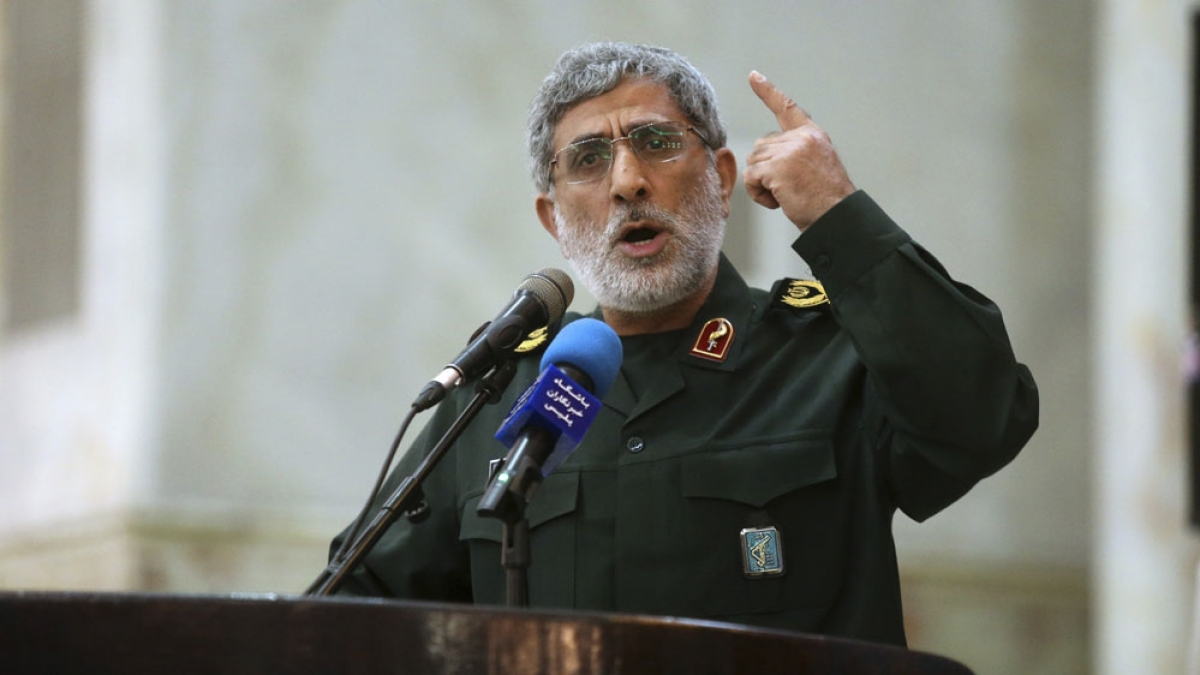
Esmail Qaani, the commander of the Quds Force within Iran's Islamic Revolutionary Guard Corps (IRGC), reportedly conducted a discreet visit to Baghdad earlier this week. The purpose of his unannounced trip was to engage in discussions regarding the Iraqi government's initiative to disarm various armed factions and consolidate all weaponry under state control. This information was disclosed by an anonymous Iraqi source affiliated with the leading Coordination Framework, an alliance of Shia Iraqi political parties.
During his visit, Qaani is said to have held private meetings with prominent Iraqi political and security figures, as well as leaders of Shia paramilitary groups. The core of these discussions revolved around the impending September 30 deadline for the Iraqi government's plan to establish a state monopoly on arms. According to the source, Iran conveyed a clear message through Qaani: "no handing over of weapons of the factions at the present time." This stance is reportedly rooted in Tehran's assessment of a potential resurgence of conflict in the region.
The Iranian communication emphasized the importance of seeking a political resolution rather than escalating confrontations between the government and armed groups unwilling to relinquish their weapons. Iraqi political parties are also reportedly opposed to employing force to implement the government's disarmament strategy.
Mounting Pressure on Iraqi Prime Minister
Iraqi Prime Minister Ali al-Zaidi is currently navigating a complex political and security landscape as the September 30 deadline for restricting weapons to state control draws near. Prime Minister al-Zaidi recently informed parliament of his administration's commitment to fulfilling a 2024 agreement with the United States-led coalition. This agreement outlines the withdrawal of the coalition's combat forces from Iraq by the end of September.
The Iraqi government's drive to monopolize arms, disarm pro-Iran factions, and its broader relationship with Tehran were central topics during Prime Minister al-Zaidi's recent diplomatic engagements. His first international trip since assuming office in May was to the United States last month, where he met with US President Donald Trump. Following this, he traveled to Tehran for discussions with Iranian President Masoud Pezeshkian.
In a recent development, Prime Minister al-Zaidi instructed the parliament's Security and Defence Committee to formulate a draft law aimed at restricting weapons to the state, aligning with constitutional provisions. He underscored the severe threat posed by unregulated weapons, asserting that they undermine the rule of law and compromise the integrity of security institutions.
Challenges to Disarmament Efforts
While some armed groups have expressed willingness to integrate into the official state armed forces, the resistance from powerful Shia paramilitary organizations, such as Kataib Hezbollah and Harakat al-Nujaba, poses a significant challenge to the government's disarmament objectives. These groups' defiant stance threatens to impede the progress of the government's initiatives.
Earlier this month, the State Administration Coalition, which comprises leading Shia parties alongside some Sunni and Kurdish political factions, issued a call for the imperative of restricting weapons to the state. The coalition declared that any entities engaging in activities that jeopardize national security outside of official institutions would be considered "outlaws that must be fought." Furthermore, the coalition hinted at the potential application of the "Anti-Terrorism Law" to any unauthorized armed activities after the government's deadline expires.
Amidst these tensions, other Shia leaders are reportedly working to de-escalate the situation. Ammar al-Hakim, head of the Hikma Movement, is reportedly spearheading efforts to persuade the various factions to move towards state control of weapons within the remaining timeframe, according to an Al Jazeera source.
Regional Security Implications
Ghazi Faisal, the head of the Iraqi Center for Strategic Studies, warned that the continued retention of arsenals by Iraqi factions could escalate into a broader regional security crisis. Faisal suggested that if these factions utilize Iraqi territory and their military capabilities to target neighboring countries, it could provoke direct responses or lead to the formation of joint security arrangements to counter these threats.
He further elaborated that any new regional security alliances aimed at safeguarding Gulf security and strategic waterways might find it necessary to address these armed factions as integral components of the regional security equation, rather than merely as Iraqi political entities. Faisal emphasized that the most pragmatic path forward involves firmly establishing the principle of restricting weapons and vesting the authority for decisions concerning war and peace solely with Iraqi constitutional institutions. He concluded that a state unable to monopolize the use of force cannot fully guarantee its national security.
Last week, Baghdad experienced a period of heightened security tensions following threats from armed factions to retaliate against alleged Saudi-US attacks on Popular Mobilisation Forces sites late last month. The US Central Command had previously stated that it conducted joint attacks with Saudi Arabia on July 28 "against Iran-aligned terrorists" reportedly directed by the IRGC to target US forces and Saudi energy infrastructure. The Kingdom's Ministry of Foreign Affairs also accused "Iran-backed terrorist militias" in Iraq of pursuing "an irresponsible path of escalation" through drone attacks against Saudi Arabia. However, concerted efforts by the Iraqi government and political factions ultimately succeeded in containing the tension, paving the way for de-escalation and diplomatic engagement.