Iran Rejects US Claims on Hormuz Control Amid Stalled Peace Efforts
In a significant development concerning the critical Strait of Hormuz, Iran has firmly rejected claims by US President Donald Trump regarding American 'total control' of the waterway. Iranian officials have stated that the strait will remain inaccessible until the United States accedes to Tehran's demands and alters its current 'behavior'. This stance was articulated by Mohsen Rezaie, the newly appointed head of Iran's Supreme National Security Council, during a meeting with China's ambassador to Tehran, Cong Peiwu. According to the semi-official Tasnim news agency, Rezaie emphasized that the Strait of Hormuz would not reopen as long as the US maintains its current posture and fails to meet Iran's conditions.
The Strait of Hormuz, a narrow passage through which approximately one-fifth of the world's oil and natural gas traverses during periods of peace, has become a focal point in the ongoing US-Israel conflict with Iran. Its closure by Iran followed the commencement of US-Israeli bombing campaigns against Iran in late February. Currently, Iran maintains that it is engaged solely with Oman, whose territorial waters also encompass parts of the strait, regarding the future management of this crucial maritime route. Commercial shipping in the strait continues to face severe disruptions, with recent incidents including US forces targeting a vessel in the Gulf of Oman, which they alleged was bound for an Iranian port. Concurrently, in the Bab al-Mandeb Strait, Yemeni authorities reported that six individuals lost their lives in an attack attributed to Houthi forces on a Saudi cargo vessel, marking what is believed to be the first fatalities from Houthi maritime attacks since the onset of the US-Israel conflict with Iran.
Escalating Tensions and Diplomatic Stalemate
The recent events raise pressing questions about the potential for the conflict to enter a more perilous phase and the viability of diplomatic solutions. President Trump's assertion, delivered at Joint Base Andrews, was that the US exercises 'total control' over the Strait of Hormuz, stating, 'nobody else, only us.' However, reports from the United Kingdom Maritime Trade Operations indicate a more complex reality on the ground, with shipping levels reduced and persistent 'harassment activity' in the Strait of Hormuz, as both Iran and the US uphold blockades in and around the area.
Iran has unequivocally stated that it will not reopen the waterway unless Washington fulfills its demands. These include the lifting of sanctions, the release of frozen Iranian assets, and compensation for damages incurred from attacks, among other stipulations. Mohsen Rezaie, through a post on X, also called for an end to the US naval blockade on Iranian ports and a comprehensive region-wide ceasefire, encompassing Gaza and Lebanon.
Maritime Incidents in Hormuz and Bab al-Mandeb
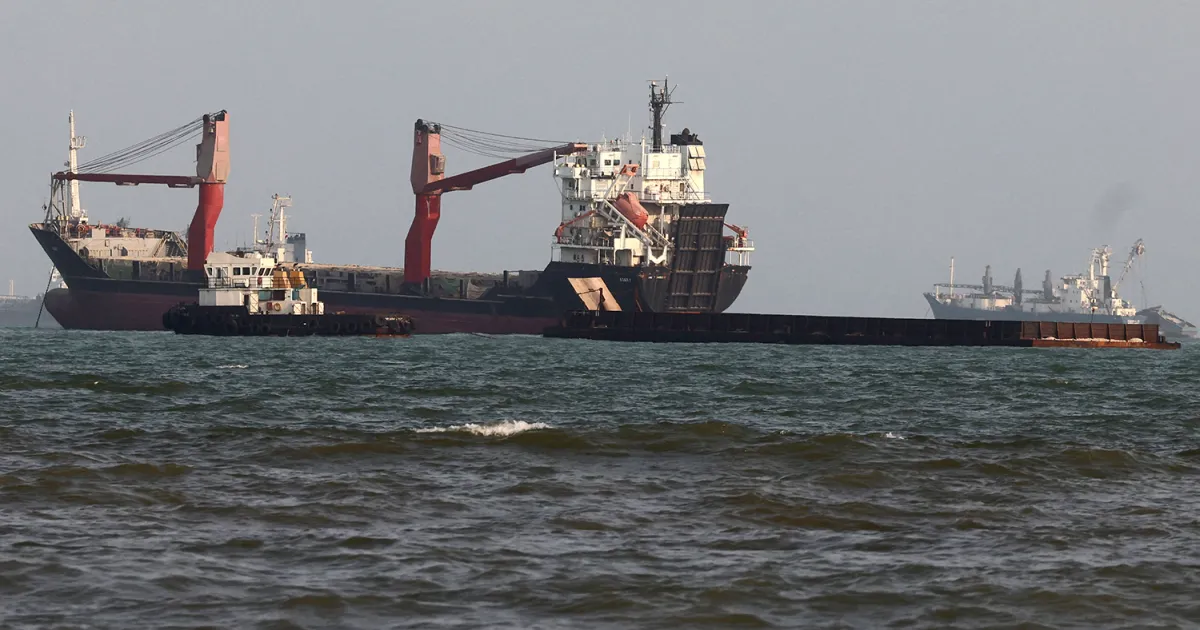
Further exacerbating the situation, a US Navy MH-60 helicopter reportedly fired two Hellfire missiles at a Panama-flagged cargo ship, the M/V Vela Nova, in the Gulf of Oman. US Central Command (CENTCOM) stated that this action followed the vessel's alleged attempt to breach the US blockade of Iranian ports and its failure to heed warnings. The strike disabled the ship's steering gear and engine room, though no casualties among the crew were reported. The conflict has also extended to the Bab al-Mandeb Strait, a vital maritime chokepoint at the entrance to the Red Sea, where Iran-backed Houthis have been targeting Saudi shipping amidst renewed fighting in Yemen. Saudi Arabia has responded by announcing a new maritime alliance aimed at securing this waterway. The Houthi attack on the Egyptian-owned Tihamah cargo vessel resulted in the deaths of four crew members and two Yemeni rescuers, with ten others injured. While the Houthis have not directly commented, affiliated media later claimed the ship was transporting Saudi military equipment.
Both the Strait of Hormuz and the Bab al-Mandeb are critical maritime arteries. Beyond the significant oil and natural gas trade through Hormuz, approximately 11 percent of global oil and 8 percent of liquefied natural gas (LNG) trade passes through Bab al-Mandeb. The ongoing conflict has severely impacted traffic through these channels, contributing to a surge in global oil prices. Shipping data from Kpler, cited by Reuters, indicated a drop in vessels transiting the Strait of Hormuz to a one-week low, with only eight vessels recorded on a recent Tuesday, significantly below the pre-war daily average of around 130 ships.
Prospects for Future Conflict and Diplomacy
The recent attacks in both Hormuz and Bab al-Mandeb strongly suggest that the conflict is not de-escalating. Despite indications last week that both the US and Iran might be open to discussions, rhetoric from both sides has intensified. US President Donald Trump recently stated his intention to demand compensation from Iran for deaths and injuries stemming from conflicts over several decades, following Iran's earlier demands for reparations related to the US-Israel war. Concerns have also been raised in US media about potential shortages of certain weapons, particularly air defense interceptors for Patriot and THAAD systems, which could pose risks to US forces and allies in the region, although Trump and other US officials have denied these claims. Meanwhile, an adviser to Iran's Islamic Revolutionary Guard Corps (IRGC) announced the development of capabilities to conduct operations on 'enemy soil,' signaling a potential expansion of Iran's operational scope beyond its previous focus on US military assets and energy infrastructure in neighboring Gulf countries and Jordan.
Oman-Iran Discussions and Broader Peace Initiatives
Regarding the Strait of Hormuz, Iranian Foreign Minister Abbas Araghchi indicated last week that negotiations with Oman concerning the future management of the strait, including new shipping lanes, were in their 'final stages' and had made progress. Iran maintains it is not engaging in direct talks with the US on this matter, preferring to collaborate with Oman on a shared management framework. Qatar's Ministry of Foreign Affairs spokesperson, Majed al-Ansari, reported receiving positive signals from both Tehran and Muscat concerning the reopening of Hormuz.
On the broader diplomatic front, Pakistani Interior Minister Mohsin Naqvi traveled to Tehran to meet with Iranian officials. His visit is part of ongoing efforts to persuade Tehran to re-engage in negotiations with Washington under an interim Memorandum of Understanding (MoU) brokered by Islamabad and Qatar in June, which is set to expire soon. The initial MoU, under which Iran had agreed to keep Hormuz open for at least 60 days, ultimately faltered due to ambiguities regarding control over the strait, leading to Iran targeting several ships using routes it had not approved. This marks Naqvi's sixth diplomatic trip to Iran in an attempt to de-escalate the US-Iran conflict. Analyst Negar Mortazavi, a senior fellow at the Center for International Policy, highlighted that the critical question for the success of future talks hinges on whether the escalatory rhetoric from both sides represents 'opening negotiating positions or actual red lines.' Mortazavi concluded that if both parties are willing to compromise, a path exists to end the conflict and reopen the strait. Conversely, a lack of compromise could lead to prolonged restrictions in Hormuz and an extended, open-ended conflict in the Middle East.