A Shifting Political Landscape in India
In a surprising turn of events, India's ruling Bharatiya Janata Party (BJP) experienced a significant political setback on the night of August 4 in Patna, a city approximately 1,000km from the national capital. The BJP lost the Bankipur constituency in Bihar's legislature, a seat it had held for three decades, to the nascent Jan Suraaj Party, led by political strategist-turned-politician Prashant Kishor. This defeat was particularly notable as the seat was previously held by BJP national president Nitin Nabin.
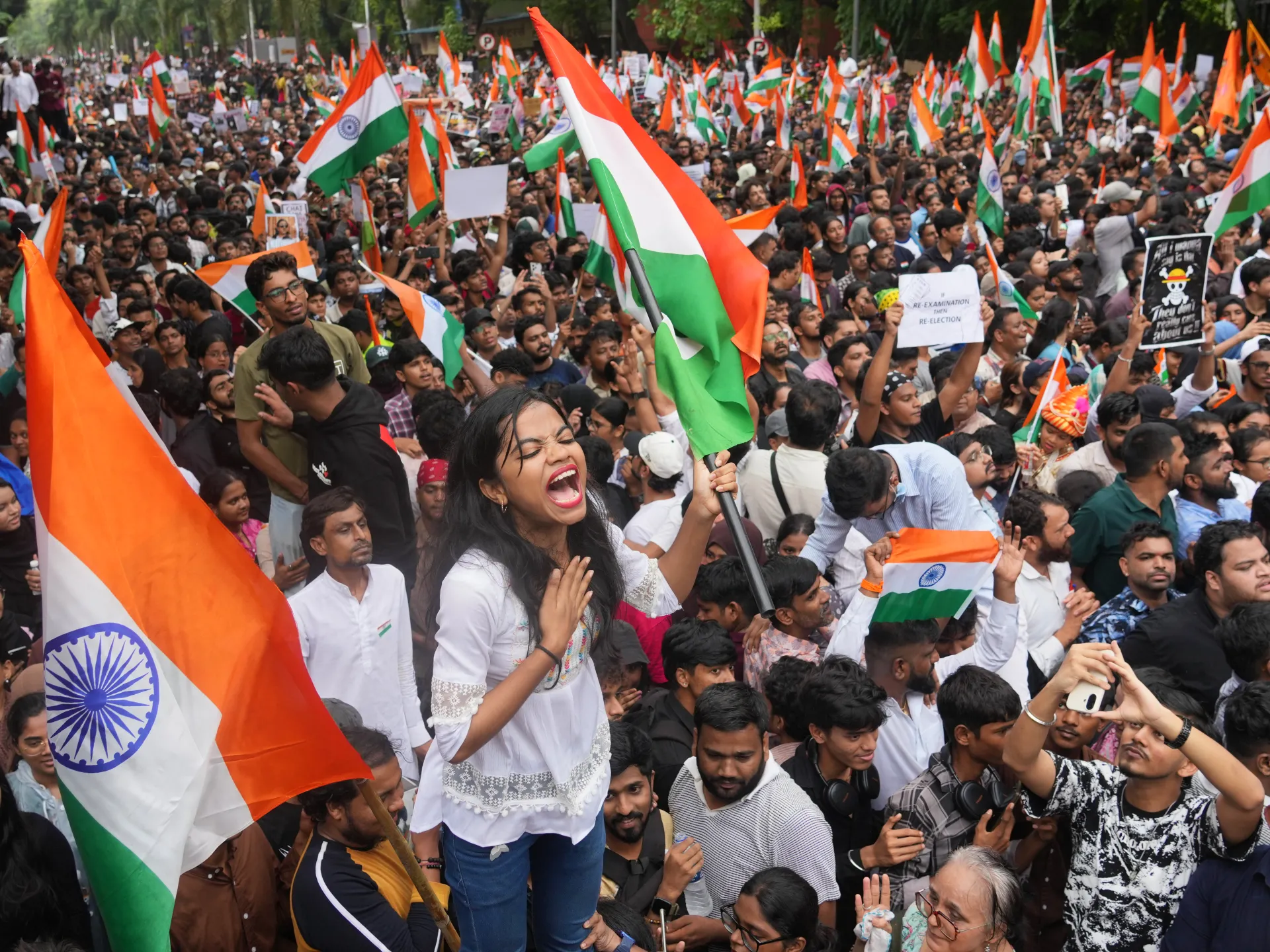
This electoral loss followed closely on the heels of another major development: the resignation of India's Education Minister Dharmendra Pradhan. His resignation came after seven weeks of student-led protests that began in New Delhi and subsequently spread to various cities across the country. These protests were spearheaded by the Cockroach Janta Party (CJP), a satirical movement that emerged on Instagram in May. The CJP's formation was a direct response to India's chief justice, Surya Kant, who controversially compared unemployed young Indians to "cockroaches" and "parasites." Nabin, the BJP chief, had further fueled the controversy during the Bankipur campaign by labeling Gen Z protesters as "a virus and a cockroach gang devoted to breaking the country." The unexpected electoral outcome in Bankipur has ignited a broader discussion among analysts regarding whether India's formidable political machine, the BJP, will be compelled to re-evaluate its strategies.
BJP's Awkward Outreach to Youth
The BJP's response to the Gen Z uprising indicates that the party views it as more than a fleeting issue. During the peak of the protests, Prime Minister Narendra Modi released a series of selfie-style videos on Instagram addressing the exam paper leaks that initially sparked the demonstrations. Reports suggest that Modi advised his cabinet colleagues to engage with young people on Instagram through reels rather than traditional media briefings, emphasizing that "young people were just on Instagram."
In Uttar Pradesh, India’s most populous state, the BJP initiated a Gen Z outreach program, deploying civil administrative officers to schools for career counseling sessions. The party also released a promotional video featuring young individuals engaging in internet slang with an older trainer, who then subtly steered the conversation toward the government's development achievements. However, the heavy use of slang in the video led to widespread mockery on Instagram, with users suggesting the party had paid young people to create propaganda aimed at their own generation. Following an incident where a Modi video briefly disappeared from Facebook, the parliamentary committee on information technology demanded an apology from Meta CEO Mark Zuckerberg.
New Delhi-based analyst Asim Ali suggests that this sudden push for social media relevance reveals a shift in the party's communication strategy. Ali notes that while the BJP once generated narratives that its supporters organically amplified, much of its current messaging appears "more managed and paid for." This approach, he argues, is less effective in a decentralized digital space that favors organic engagement over top-down control. Ali highlighted that while the party's communication machinery remains powerful due to its influence over mainstream media, it struggles to generate the same level of "organic emotional identification" on social media platforms like Instagram that it achieved between 2011 and 2014.
A Challenge to the BJP's Traditional Playbook
Gilles Verniers, a researcher at the Center for International Studies (CERI) at Sciences Po in Paris, characterizes the BJP's recent youth outreach as a "battle for perception" rather than a substantive policy shift. He points out that despite the appointment of a new education minister, the individual hails from the same background—an older figure from the Rashtriya Swayamsevak Sangh (RSS), the far-right ideological parent of the BJP. Verniers contends that the movement has effectively disrupted the BJP's customary method of dealing with dissent, which typically involves branding protesters as anti-national, foreign-funded, or terrorists, as seen during the 2019-20 protests against the Citizenship Amendment Act (CAA).
The previous strategy against protests proved ineffective this time, partly because the movement preemptively mocked itself and partly due to its diverse nature. Unlike the anti-CAA or farmers' protests, the CJP movement could not be easily associated with a single religion or community. It also attracted young people from the BJP's traditional "upper-caste" Hindu base, making it a "truly caste-blind movement," according to Verniers. This episode, he adds, has also shattered the BJP's narrative that Prime Minister Modi inherently commands the youth. Verniers observes that for the first time, the 75-year-old prime minister "appears his age," suggesting that the movement has successfully cast him as a "boomer in the public imagination," which he believes must be a significant blow.
Interpreting Electoral Outcomes and Future Trajectories
The BJP's recent by-election losses, including Bankipur in Bihar and Datia in Madhya Pradesh, have led opposition leaders to link these outcomes directly to the student protests. However, analysts urge caution in drawing definitive conclusions. Ali warns against over-interpreting the Bankipur vote, and Verniers notes that by-elections typically involve a small fraction of the electorate. He also emphasizes that the BJP's power structure has historically demonstrated resilience in absorbing setbacks. Verniers cites the example of Haryana, where the BJP secured a majority just a few years after farmers in the northern state engaged in a year-long protest against agricultural laws, demonstrating that elections can be fought on issues beyond immediate protest concerns.
Pushpendra Saroj, a 27-year-old Samajwadi Party member of parliament, was a frequent visitor to Jantar Mantar, the hub of the Gen Z protests in New Delhi. He observed the protest crowd grow significantly after activist Sonam Wangchuk was hospitalized following a hunger strike, attributing this growth to the government's perceived "aggression," including alleged cuts to power and water and a baton charge against protesters. Saroj noted that the education minister's resignation only occurred when "fingers got pointed at the prime minister directly." He also highlighted the simple human sympathy evoked by seeing "children getting beaten up."
For many involved in the New Delhi protests, the movement's significance extends beyond a satirical Instagram page or a single resignation. Anjali, a postgraduate student and secretary of the All India Students' Association (AISA), an older left-aligned group that collaborated with the CJP, views the protests as the manifestation of long-standing anger. She believes the protests are a culmination of "accumulated anger of the youth of this country for the last 12 years" and that true victory requires an end to "communal, casteist, anti-women politics." Anjali also criticized the disproportionate impact on Muslim and Dalit students, who she claims were the first to face arrests, intimidation, and police complaints, drawing parallels to the 2019 raid on Jamia Millia Islamia during the anti-CAA protests. She cited the detention of two young men in Goa for allegedly supporting jailed activists while celebrating Pradhan's exit as further evidence of this pattern.
Analysts Ali, Verniers, and Anjali concur that the CJP movement is unlikely to transition into electoral politics. Verniers considers the movement's current restraint "tactically smart," referencing the Aam Aadmi Party (AAP) which, despite its initial success as a protest movement, is now seen as a disappointment. A national political campaign would require substantial financial resources, volunteers, and organizational structure, which a young, often underemployed movement lacks. Verniers suggests that the CJP's more enduring impact will be on the agendas of other parties, acting as an "interest group, rather than as a separate political force." Anjali echoed this sentiment, stating that AISA plans to continue building its argument against the government on campuses nationwide.
Ali does not anticipate the BJP abandoning its Hindu majoritarian politics, or Hindutva, in favor of an agenda focused on jobs and education, as advocated by CJP-led Gen Z protesters. He believes the BJP would likely intensify its Hindutva agenda to ensure that religious identity remains the primary issue in any election. However, Verniers suggests that while the BJP's raw political power remains strong, its legitimacy has been dented. He notes the party's continued electoral dominance, ability to induce defections, and superior spending power as evidence of its success, yet highlights that the protests have challenged the authority behind this dominance. This growing "disconnect between the actual power that the BJP has, and its ability to have citizens comply and obey" is, according to Verniers, a significant and interesting challenge the party now faces.