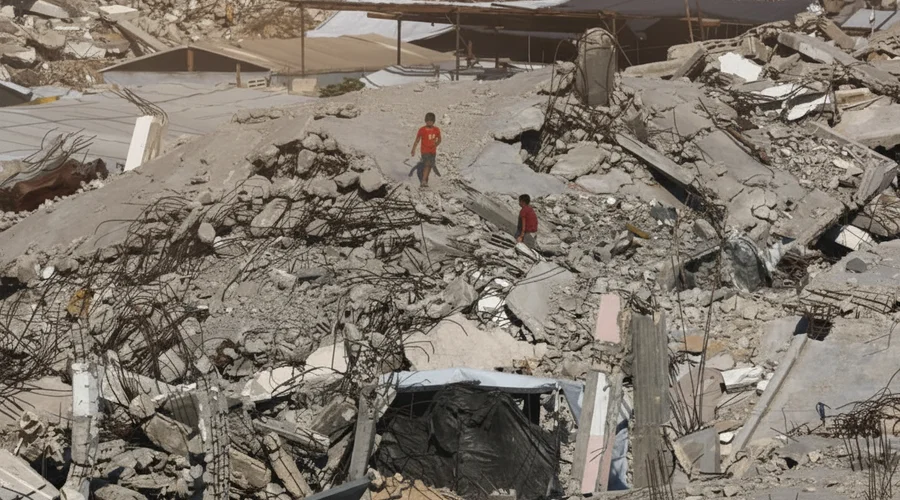
Massive Rubble Removal Operation Underway in Gaza
The Israeli military is reportedly conducting a large-scale operation to clear millions of tons of rubble from the Gaza Strip, a move that human rights groups and monitors are scrutinizing closely. This systematic reshaping of the urban environment is occurring against a backdrop of significant casualties, with tens of thousands of Palestinians, predominantly women and children, reported killed since hostilities commenced in October 2023.
Organizations such as the Euro-Med Human Rights Monitor suggest this extensive debris removal could be an effort to engineer demographics and eliminate evidence of alleged atrocities. Their report, titled 'Gaza Rapid Damage and Needs Assessment,' estimates that approximately 68 million tons of rubble are present across the Gaza Strip, largely a result of ongoing military actions. Of this, at least 10 million tons have already been relocated, crushed, or moved from their original locations within areas under Israeli military control, which encompasses about two-thirds of the enclave.
Allegations of Evidence Obliteration
Approximately 400 pieces of heavy machinery, including excavation, crushing, and transport equipment, are reportedly involved in demolishing remaining structures in Gaza. Nearly 100 Israeli trucks are said to be transporting debris daily from the Gaza Strip to undisclosed locations within Israel and the occupied West Bank.
Budour Hassan, a researcher with Amnesty International, indicated that these actions might be a deliberate strategy to destroy evidence of alleged crimes committed during the conflict. Hassan stated that the bulldozing is an integral part of efforts to destroy land in Gaza, and there are significant concerns that these operations aim to obliterate and conceal evidence. Preventing access to such evidence would pose a direct challenge to the International Court of Justice (ICJ), which is currently hearing a genocide case against Israel initiated by South Africa and supported by numerous other nations. Hassan further emphasized that the occupation systematically works to erase evidence and the characteristics of alleged crimes.
Mohammed Salha, director of the NGO Network in the Gaza Strip, believes that the debris being removed from the enclave likely contains fragments of missiles, ammunition, and personal belongings, all of which could be crucial for future accountability. Salha stated that moving and fragmenting this rubble into the Green Line is an attempt to obliterate evidence and facts. He highlighted that thousands of deceased individuals are believed to be beneath this rubble, and moving it, along with their remains, signifies a deliberate destruction of potential crime scenes containing essential evidence that could expose alleged war crimes, crimes against humanity, and genocide.
Urban Engineering and Demographic Shifts
The large-scale removal of rubble may also serve distinct military and colonial objectives. The Euro-Med Monitor report suggests that crushing and removing rubble on such a scale destroys land boundaries, house foundations, and street networks, thereby stripping Palestinians of physical markers of ownership and potentially deepening ethnic cleansing in Gaza. This could, in turn, facilitate efforts to re-establish Israeli settlements in the territory.
Retired Brigadier General Elias Hanna, a military and strategic expert, explained that geography is being weaponized against the population as an extreme form of collective punishment. He noted that when the Israeli military destroys and bulldozes, it falls within a policy of collective punishment, creating a new urban engineering and a different social and security environment to penalize those who resist and the civilian population. This strategy of urban engineering aims to permanently alter the enclave's ecosystem by preventing Palestinians from returning to their homes and rendering destroyed areas unlivable or unsuitable for reconstruction.
The Daily Tragedy and Impeded Recovery Efforts
The removal of ruins also carries the grim implication that the bodies of missing individuals, estimated by Gaza's civil defense in July 2026 to be around 8,500, could be permanently lost. The use of heavy machinery without prior forensic surveys risks crushing or scattering these remains, severely infringing upon families' rights to ascertain the fate of their relatives.
Abu Asim, a Palestinian citizen whose family members are still buried in eastern Gaza, now designated as a military 'Yellow Line' area, shared his anguish. He recounted that his family members' body parts were scattered in the streets, and some remain under the rubble of their home, their remains unrecovered. He lamented the double tragedy: their martyrdom and the ongoing absence of graves and evidence needed to prosecute alleged crimes.
Rescue efforts have been entirely paralyzed in areas seized by the Israeli military. Samir al-Mana'ama, a lawyer with the Al Mezan Center for Human Rights, reported that Israeli authorities have taken control of approximately 70 percent of the eastern Gaza Strip during the conflict. He stated that the Israeli military is preventing rescue crews from accessing these areas to recover bodies and is tampering with rubble, moving it from place to place, which constitutes a clear violation of international humanitarian law and international human rights law.
Raed al-Dahshan, director of civil defense in Gaza, highlighted the extreme difficulty of their mission. He explained that operations in accessible areas are already very challenging, and the situation would be even more complex if coordination were required to enter areas within the 'Yellow Line,' which demand specialized equipment, coordination, and security. Even known burial sites have not been spared, with reports indicating that over 93 percent of cemeteries in the Gaza Strip have been partially or completely destroyed. Salha concluded that neither structures, nor people, nor even the deceased in their graves have been immune from the impact of these operations.