
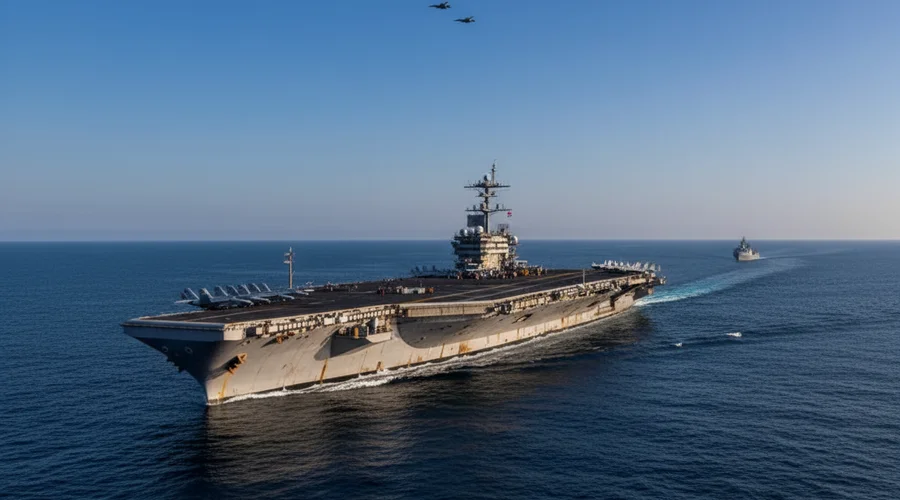
The USS Abraham Lincoln's Prolonged Mission and Its Impact
The USS Abraham Lincoln, a flagship aircraft carrier, has been engaged in an extended deployment in the Middle East for nearly nine months. This prolonged mission has reportedly led to a mental health crisis among its crew, with some sailors allegedly attempting to jump overboard, according to various US media outlets. Family members of the more than 5,000 personnel aboard the vessel, believed to be operating in the Gulf region, have also reported issues such as food shortages and unsanitary conditions due to broken facilities like toilets and showers, contributing to poor health among the crew.
The carrier departed its homeport of San Diego on November 21, 2025, for what was intended to be an extended deployment spanning the Asia Pacific and the Middle East. Its primary role has been maritime security and blockade operations, particularly around the Strait of Hormuz. Since its departure, the ship has only made one brief, single-day port call at Naval Base Guam in December. Naval experts emphasize that the lack of regular port visits is a significant concern for a vessel of the USS Abraham Lincoln's size and operational complexity.
These issues have surfaced as US President Donald Trump and Defense Secretary Pete Hegseth have indicated a readiness to maintain an 'indefinite' blockade on Iranian ports in the Gulf. The situation on the USS Abraham Lincoln prompts an examination of how its current deployment compares to other lengthy aircraft carrier missions in naval history.
Reports from Aboard the USS Abraham Lincoln
Military-focused publications, the Navy Times and Stars and Stripes, recently published reports quoting family members of the crew who described a decline in mental health and morale, alongside instances of suicidal ideation. One sailor's wife, identified as Annabelle Loma, told the Navy Times that her husband had attempted to jump overboard due to 'severe burnout.' These reports have prompted inquiries from US lawmakers.
Admiral Brad Cooper, commander of US Central Command (CENTCOM), reportedly visited the USS Lincoln. While acknowledging the unique challenges of long periods at sea, he praised the crew and claimed the ship had the lowest number of mental health-related cases among the Navy's active aircraft carriers. However, both Republican and Democratic lawmakers have expressed growing concern regarding accountability, especially after Secretary Hegseth dismissed the mental health reports as 'completely misrepresented.' President Trump, when asked about the duration of the USS Lincoln's deployment, remarked, 'No, not nearly long enough.'
The USS Lincoln's mission, initially scheduled to conclude in May, has been repeatedly extended. It was recently announced that the USS George Washington, currently in the Pacific, would be rerouted to the Gulf to relieve the Lincoln within the coming week.
Historical Context of Aircraft Carrier Deployments
US aircraft carrier deployments have varied significantly in length throughout history. The longest deployment since the Vietnam War was the USS Gerald R Ford's 326-day mission, which commenced in June 2025 during President Trump's second term. This mission encompassed NATO exercises, support for a US military operation in Venezuela, and operations in the Red Sea during the US-Israel conflict with Iran. After initially serving in the Asia Pacific and South China Sea, the USS Ford was deployed to the Arabian Sea and the Gulf of Oman to enforce a naval blockade of Iranian ports. During this period, the USS Ford encountered several technical issues, including an onboard fire, which also garnered congressional scrutiny.
Some of the most protracted aircraft carrier deployments in US history occurred during the Vietnam War, particularly in the Gulf of Tonkin. The USS Midway operated for 332 days, the USS Coral Sea for 329 days, and the USS Saratoga for 308 days. Similar to the current challenges faced by the USS Lincoln, these vessels also experienced difficulties. Reports from that era indicated that the intense flight schedules associated with active air combat pushed both crew and operations to their limits.
While other nations have conducted lengthy aircraft carrier deployments, they generally do not compare to the duration of US Navy missions. Russia's Admiral Kuznetsov undertook a five-month mission to the Syrian coast in October 2016 but was plagued by technical breakdowns and aircraft losses. The United Kingdom's HMS Queen Elizabeth completed a seven-month deployment in 2021, including combat strikes in Iraq and Syria, despite significant engineering issues.
The Critical Nature of Sustained Naval Readiness
The conditions on the USS Abraham Lincoln have prompted lawmakers to question the feasibility of maintaining an 'indefinite' blockade in the Gulf. Senator Richard Blumenthal, in a letter to Secretary Hegseth, highlighted concerns over deteriorating mental health, shortages of basic supplies, water contamination, increased safety incidents, and disruptions to mail services. Blumenthal questioned whether the Navy can sustain its current operational tempo, especially given the administration's increasing reliance on aircraft carriers for prolonged conflicts.
Experts emphasize that the lack of port stops is a critical factor for the USS Abraham Lincoln. Harlan Ullman, a retired senior naval officer and chairman of the strategic advisory firm Killowen Group, explained that advanced naval vessels require onshore maintenance to ensure the long-term operational integrity of their complex technology. He noted that while some maintenance can be performed at sea, many crucial tasks can only be completed in port. Ullman stressed that extended deployments without adequate port calls 'erode the readiness and capability of that ship the longer it's at sea, and it lacks the ability to repair and extend maintenance.' He urged the administration to prioritize naval readiness over political considerations, viewing it as a national issue requiring proactive solutions rather than a defensive stance.
Drawbacks of Extended Aircraft Carrier Deployments
Aircraft carriers are designed for extended deployments, often spanning many months. However, this comes at a considerable cost. Prolonged cruises heighten the risk of technical failures and can significantly impact crew morale and mental well-being. These large vessels are also incredibly expensive; the USS Abraham Lincoln, built in 1989, cost $2.2 billion and incurs tens of millions of dollars in daily operating expenses.
Recent conflicts have also highlighted the potential vulnerabilities of large aircraft carriers. For instance, Houthi rebels, despite lacking a formal navy, have been able to exert pressure on US Navy aircraft carriers operating within missile range. During the US-Israel conflict with Iran, the USS Gerald Ford was reportedly compelled to operate hundreds of miles from the Iranian coast to mitigate the risk of missile strikes, thereby limiting its operational effectiveness.