
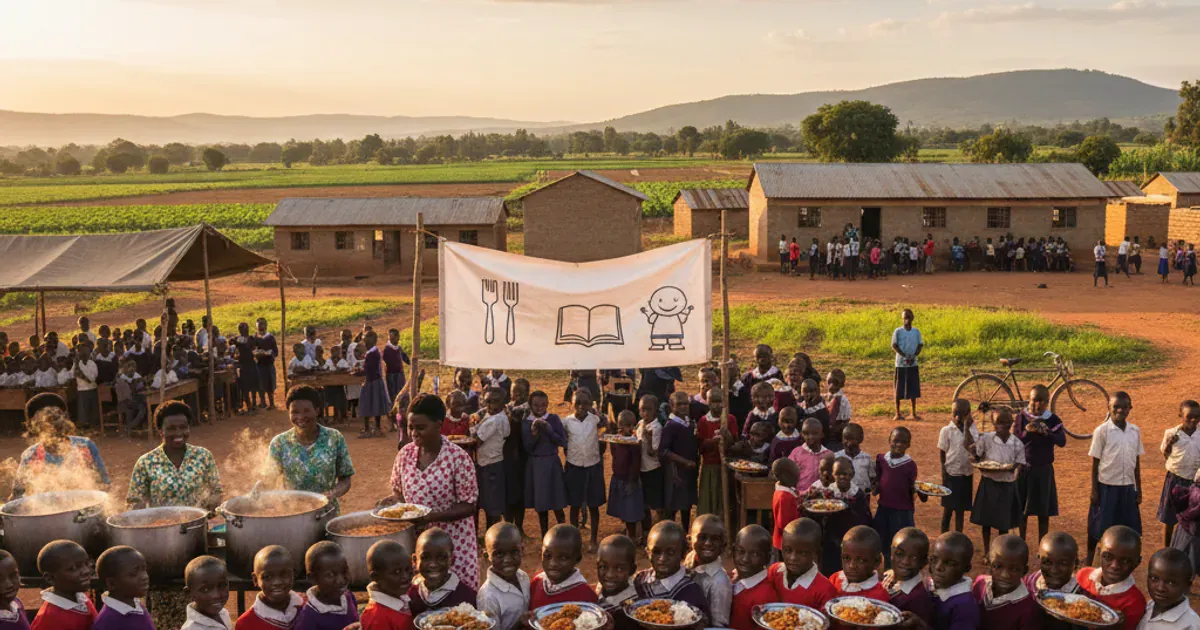
In Nairobi, Governor Johnson Sakaja has shown that sometimes the most powerful education policy is not a new curriculum, a new building, or a new slogan.
Sometimes, it is a hot meal.
Through the Dishi na County school feeding programme, Nairobi is now feeding more than 324,000 children every school day across 230 public schools in all 17 sub-counties. The programme has already delivered more than 85 million meals and is moving toward the historic milestone of 100 million meals served. The Star
What makes this impressive is not only the scale. It is the philosophy behind it.
Sakaja understood a simple truth: a child who is hungry cannot learn properly. And in many families, especially in difficult economic times, school attendance is not only about education. It is also about survival. If school guarantees a nutritious, affordable meal, parents are more likely to send their children, and children are more likely to stay.
That is why Dishi na County is more than a food programme. It is an attendance programme. It is a social protection programme. It is an education programme. It is a dignity programme.
For just KSh 5, children receive a hot meal, easing pressure on families while giving learners a real reason to come to class and remain there. Sakaja has said clearly that the objective is not only to feed children, but to keep them in school. Eastleigh Voice
This is the kind of public policy that feels obvious only after someone has the courage to execute it.
The model is also interesting because it is operationally serious. Nairobi partnered with Food for Education, a Kenyan organization recognized for building scalable school-feeding systems. Food4Education has become one of Africa’s leading locally run school meal initiatives, with a model based on centralized kitchens, local sourcing, technology, and community employment. TIME
This is what makes the Nairobi example powerful: it is not charity. It is infrastructure.
When a city can cook, deliver, and serve hundreds of thousands of meals every day, it is building a new layer of public capacity. It is proving that government can solve real problems at scale when leadership, execution, and partnerships align.
The result is also deeply human. Behind every statistic is a child who can concentrate in class. A parent who has one less impossible choice to make. A teacher who faces a classroom of children who are more present, more focused, and more ready to learn.
In Africa, and far beyond Africa, education policy often focuses on long-term reform. But sometimes the fastest way to improve education is to remove the obstacle standing at the school gate.
In Nairobi, that obstacle was hunger.
Johnson Sakaja’s Dishi na County programme shows that feeding children is not a side issue. It is central to education, equality, and national development.
Because when you feed a child, you do not only fill a plate.
You open a classroom door.