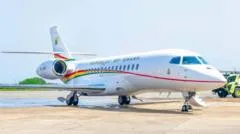
The delivery of the Falcon 6X and its procurement context
The Dassault Aviation Falcon 6X arrived at the Ghana Air Force on Monday, receiving a water salute upon its delivery. Although the reported cost of the aircraft is $61m, the government has identified the investment at approximately $60m (£46m). This acquisition was not an isolated purchase but was approved by Parliament last December as a component of a broader strategic initiative to modernise the military aviation capabilities of Ghana.
The modernisation programme includes several assets beyond the presidential aircraft, such as four helicopters provided by Airbus. By integrating the Falcon 6X, the government aims to enhance the reliability and operational reach of the state's executive travel. The decision to proceed with the purchase follows a period of significant financial instability for the nation, which previously necessitated assistance from the International Monetary Fund (IMF).
Modernisation of the aviation fleet
The procurement of the Falcon 6X is part of a structured effort to upgrade the Ghana Air Force's technical capacity. This includes not only the presidential transport but also tactical support through the acquisition of Airbus helicopters. The government maintains that these upgrades are essential for national security and administrative efficiency.
Political opposition and accusations of hypocrisy
Opposition politicians have challenged the government's decision, specifically questioning why the National Democratic Congress (NDC) is pursuing a purchase that its own leaders previously opposed. Member of Parliament Samuel Abu Jinapor has been a vocal critic, suggesting that the administration's change in stance is a matter of political convenience rather than necessity.
Jinapor argued that the expenditure is difficult to justify while many citizens face high youth unemployment and a rising cost of living. He noted that the principles held by the NDC while in opposition should remain consistent even after taking power. "What was unacceptable in opposition cannot suddenly become acceptable in government merely because the occupants of power have changed," Jinapor stated, while also calling for transparency regarding the procurement process and the specific methods used to finance the $61m aircraft.
Government justifications and economic arguments
The administration has defended the purchase by citing the improved macroeconomic stability of Ghana as a primary justification. Peter Lanchene Toobu, chairman of the parliamentary defence committee, clarified that the NDC's previous opposition to a new jet was based on timing rather than principle. He noted that the party had previously argued against such spending while the country was undergoing a $3bn IMF bailout process.
According to Toobu, the current economic strength and a more stable Ghanaian currency have made the purchase feasible without resorting to new debt. Government spokesperson Kwakye Ofosu supported this view, pointing to deflationary trends in certain sectors as evidence of recovery. Ofosu cited the falling cost of construction materials as a metric for this improved stability, noting that cement prices had dropped from 115 cedis (£7.5) per bag during the 2024 campaign to 80 cedis today.
Technical necessity and aircraft specifications
A central argument for the new jet is the deteriorating condition of the current presidential aircraft, a 16-year-old Falcon 900EX. The government has highlighted several recurring technical failures with the older model that impact the safety and efficiency of presidential travel. These issues include fuel tank leakages and significant corrosion problems.
The reliability of the Falcon 900EX was notably compromised in 2025, when the aircraft was reportedly grounded in France for several months to undergo essential repairs. The new Falcon 6X offers a superior flying range, which officials say will minimize the frequency of refueling stops during long-distance international missions, thereby streamlining the president's schedule and increasing operational reliability.
Addressing luxury and interior claims
The debate has also touched upon the luxury features of the new aircraft. Following social media speculation regarding a dedicated bedroom and bathroom, Kwakye Ofosu addressed these claims directly to mitigate public backlash regarding perceived extravagance.
Ofosu denied the existence of a dedicated bedroom, explaining that the aircraft features reclining seats designed to be converted into sleeping arrangements. He also dismissed reports of a luxury bathroom, stating that the president has no intention of "bathing in the air." By clarifying these specifications, the government seeks to distance the purchase from the image of unnecessary opulence.
Public reaction and social media criticism
Beyond the halls of Parliament, the purchase has faced intense scrutiny on digital platforms. Many citizens have expressed frustration, viewing the $60m expenditure as a misalignment of national priorities. The criticism often focuses on the opportunity cost of the funds, with social media users suggesting the money could have been diverted to social services.
On the platform X, users have quantified the potential impact of the expenditure, with one post suggesting that the funds could have been used to employ over 100,000 nurses and 200,000 teachers. This sentiment reflects a broader tension between the government's narrative of economic recovery and the lived experience of a population still navigating the complexities of high living costs and employment challenges.
| Economic Indicator | Reported Change/Status | Source/Context |
|---|---|---|
| Cement Price (per bag) | Dropped from 115 cedis to 80 cedis | Kwakye Ofosu, Government Spokesperson |
| IMF Status | Previous $3bn bailout period cited | Peter Lanchene Toobu, Defence Committee |
| Financing Method | Purchased without new borrowing | Government Statement |